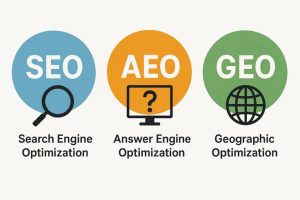
SEO vs GEO vs AEO — Understanding the Difference Between Three Global Growth Systems
In the modern world, three short acronyms—SEO, GEO, and AEO—are shaping how we grow, connect, and operate across industries. You’ve probably heard of SEO if you work online, GEO if you deal with maps or data, and AEO if you trade internationally.
But what do these three really mean? How do they work? And what makes them so different from each other?
In this blog, we’ll break down SEO (Search Engine Optimization), GEO (Geographical / Earth Observation), and AEO (Authorized Economic Operator)—exploring their meanings, purposes, real-world uses, and why all three matter in today’s digital and global economy.
💻 What Is SEO?
SEO stands for Search Engine Optimization — the art and science of improving your website’s visibility on search engines like Google, Bing, and Yahoo.
Whenever you search for something online, search engines show results based on how relevant and optimized a website is. SEO helps websites rank higher, attract organic traffic, and reach the right audience.
In simple words:
SEO is about helping people find you online easily.
🔹 How SEO Works
SEO involves improving three main areas:
-
On-Page SEO: Optimizing content, keywords, titles, and meta descriptions.
-
Off-Page SEO: Building backlinks and improving domain reputation.
-
Technical SEO: Making sure your website loads fast, is mobile-friendly, and easy for search engines to crawl.
🌐 Example:
If you run a digital marketing agency and someone searches for “best SEO services near me,” good SEO ensures your website appears on the first page of Google.
⚙️ Tools Used:
-
Google Search Console
-
SEMrush
-
Ahrefs
-
Yoast SEO
-
Moz
💡 Why SEO Matters:
-
Builds trust and credibility
-
Drives free, organic traffic
-
Boosts sales and leads
-
Strengthens brand awareness
SEO is your online engine for digital visibility and growth.
🌎 What Is GEO?
GEO stands for Geographical / Earth Observation. It’s all about using satellites, sensors, and mapping systems to collect and analyze data about the Earth’s surface and environment.
In simple terms:
GEO helps us understand the planet — where things are, how they move, and what changes over time.
🔹 How GEO Works
GEO uses technologies like:
-
Satellites and Drones for imaging
-
GIS (Geographic Information Systems) for mapping
-
GPS (Global Positioning System) for tracking
-
Remote Sensing for monitoring natural changes
🌐 Example:
When weather satellites predict storms, or when Google Maps shows traffic conditions, that’s GEO in action.
⚙️ Tools Used:
-
Google Earth
-
ArcGIS
-
QGIS
-
NASA Worldview
-
Copernicus Open Access Hub
💡 Why GEO Matters:
-
Supports environmental monitoring
-
Improves urban planning
-
Helps manage natural disasters
-
Aids smart agriculture and logistics
GEO connects us to the Earth — turning raw data into insights that protect the planet and improve human life.
🚢 What Is AEO?
AEO stands for Authorized Economic Operator. It’s a certification program under the World Customs Organization (WCO) that recognizes trusted businesses engaged in international trade.
An AEO-certified company is one that customs authorities consider safe, compliant, and reliable.
In simple words:
AEO builds trust and security in global trade.
🔹 How AEO Works
Companies applying for AEO must prove they follow customs laws, maintain secure supply chains, and keep accurate records. Once certified, they get faster customs clearance, fewer checks, and international recognition.
🌐 Example:
An exporter with AEO status can ship goods more quickly across borders, saving time and reducing costs.
⚙️ Tools / Frameworks Used:
-
WCO SAFE Framework
-
Mutual Recognition Agreements (MRAs)
-
Customs compliance audits
💡 Why AEO Matters:
-
Reduces customs delays
-
Lowers financial guarantees
-
Boosts trade efficiency
-
Builds trust and credibility globally
AEO strengthens the backbone of world trade — combining compliance with convenience.
⚖️ Comparing SEO vs GEO vs AEO
Now that we understand each concept, let’s see how they differ:
| Aspect | SEO (Search Engine Optimization) | GEO (Geographical / Earth Observation) | AEO (Authorized Economic Operator) |
|---|---|---|---|
| Full Form | Search Engine Optimization | Geographical / Earth Observation | Authorized Economic Operator |
| Field | Digital marketing / Internet | Geography / Environmental science | International trade / Customs |
| Purpose | To improve online visibility | To monitor and analyze the Earth | To secure and simplify global trade |
| Main Focus | Ranking on search engines | Understanding Earth’s environment | Ensuring safe and efficient trade |
| Users | Digital marketers, content creators, businesses | Scientists, governments, planners | Importers, exporters, logistics companies |
| Tools Used | Google Analytics, SEMrush, Yoast | Satellites, GIS, GPS, drones | WCO Framework, customs software |
| Output | Website ranking, online traffic | Maps, imagery, environmental data | Trade certification, faster clearance |
| Core Benefit | Visibility and brand growth | Spatial intelligence and sustainability | Trust, speed, and global recognition |
| Example | Ranking first on Google for a keyword | Tracking deforestation via satellite | Faster customs clearance for certified traders |
🌐 How They Intersect
While SEO, GEO, and AEO belong to different domains, they all share one common goal — efficiency through intelligence.
Let’s see how they sometimes connect:
-
SEO + GEO: Businesses use local SEO (geo-targeting) to reach nearby customers. Example: A restaurant optimizes its Google Maps listing for local visibility.
-
GEO + AEO: Customs authorities use GEO mapping to monitor international shipments, helping AEO-certified companies move goods securely.
-
SEO + AEO: Logistics or trade companies use SEO to promote their AEO-certified services online.
Each system — whether digital, spatial, or trade-based — improves trust, accuracy, and growth in its own unique way.
💼 Practical Uses in Different Fields
| Industry | SEO Helps With | GEO Helps With | AEO Helps With |
|---|---|---|---|
| Business & Marketing | Online visibility, lead generation | Location-based targeting | Trusted international trading |
| Government | Information dissemination | Smart city planning | Trade regulation and security |
| Environment | Public awareness campaigns | Climate monitoring | Eco-friendly import/export compliance |
| Education | Website ranking for institutes | Geographic research | Training on global trade systems |
| Logistics | Digital brand visibility | Route optimization | Faster border clearance |
Each acronym serves a unique ecosystem — but together, they power the digital, environmental, and trade worlds.
🚀 The Future of SEO, GEO, and AEO
🔹 The Future of SEO
-
More AI-driven algorithms (like Google Gemini)
-
Focus on voice search and visual search
-
Enhanced local SEO for small businesses
🔹 The Future of GEO
-
Integration of AI with satellite data
-
Smart cities powered by geospatial insights
-
Climate change tracking at micro levels
🔹 The Future of AEO
-
Fully digital customs systems
-
Blockchain for trade transparency
-
Global AEO recognition across all countries
The future belongs to systems that combine data, technology, and trust.
🌍 Key Takeaways — SEO vs GEO vs AEO
| Parameter | SEO | GEO | AEO |
|---|---|---|---|
| Meaning | Improves visibility on search engines | Observes and analyzes Earth data | Certifies trusted traders in global commerce |
| Goal | Boost digital growth | Protect and understand the planet | Secure and simplify global trade |
| Who Uses It | Marketers and businesses | Scientists and governments | Exporters and importers |
| Impact Area | Online presence | Environment & space | Global trade and economy |
| Outcome | Higher search ranking | Data-driven insights | Faster, safer trade operations |
In summary:
-
SEO connects people to information.
-
GEO connects data to the Earth.
-
AEO connects businesses to global markets.
💬 Final Thoughts
In our interconnected world, SEO, GEO, and AEO each represent a different dimension of growth:
-
SEO builds visibility in the digital world.
-
GEO builds awareness in the physical world.
-
AEO builds trust in the economic world.
Though they operate separately — one online, one in space, and one in trade — all three share a common mission: to make systems smarter, faster, and more reliable.
So, whether you’re optimizing your website (SEO), analyzing satellite data (GEO), or exporting goods (AEO), you’re part of a global ecosystem that thrives on data, trust, and innovation.
That’s the true connection between SEO, GEO, and AEO — three small acronyms that power the modern world.